
What are the 8 Senses Sensory Processing
Children have eight senses, not five. The three most parents have never heard of often explain the behaviours that worry them most.
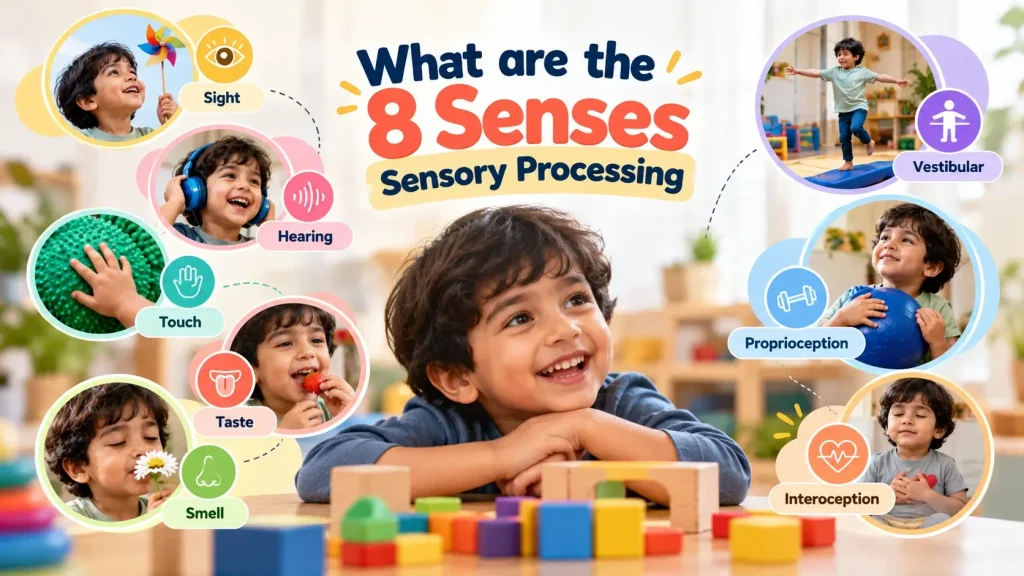
As a sensory integration occupational therapist, I often work with children who put their hands over their ears at birthday parties, accept only a handful of foods, bump into furniture on purpose, find it hard to concentrate, or get tired out by writing. It is rarely bad behaviour. In most cases, the child’s brain handles sensory information in a different way. This affects how well they pay attention, how they write, and how they get through their day.
The five familiar senses
- Sight: helps a child see, track and tell shapes apart. Look for: squinting in bright light, losing place when reading, reversed letters. Try: a tidy, uncluttered homework space.
- Hearing: Hearing is not only about picking up sounds. It is also about how the brain sorts sounds and makes sense of them. Look for: covering ears, missing instructions, constant humming. Try: Give one instruction at a time, and keep background noise low.
- Touch: senses texture, temperature and pressure. Look for: hating clothing tags, messy hands or hair brushing, or not noticing scrapes. Try: messy play with dough or sand at the child’s own pace.
- Taste: goes with mouth feel. Look for: very few accepted foods, gagging on textures, chewing on clothes. Try: exploring new foods without pressure to eat.
- Smell: is tied to emotion and comfort. Look for: avoiding the kitchen or washroom, or sniffing everything. Try: unscented products and letting the child choose scents.
The three hidden senses
- Vestibular (movement and balance): supports posture, balance and alertness. Look for: constant spinning and climbing, or fear of swings and stairs; slouching at the desk. Try: daily swinging, rolling and obstacle courses.
- Proprioception (body position and force): tells a child where their body is and how hard to push. Look for: stomping, slamming, bumping into things, breaking pencil leads. Try: heavy work such as carrying bags, wall push-ups and wheelbarrow walks.
- Interoception (inner body signals): senses hunger, thirst, a full bladder and feelings. Look for: sudden toilet urgency, not noticing thirst, meltdowns with no warning. Try: asking “What is your tummy telling you?” and scheduling toilet and water breaks.
You can buy this product to help your child to full fill their sensory therapy: Sensory Play & Exploration
Why it matters for attention and handwriting
When we feel settled in the body, our brain finds it easy to pay attention and concentrate. If the body signals irritability from touch of tag, or needs movement or feels uneasy – functional tasks like paying attention or handwriting look difficult. Sitting upright, holding a pencil with steady pressure and controlling the hand all depend on vestibular, proprioceptive and touch input. Therefore, children who show inability to sit for longer time, touching things around and not following commands are often observed from the sensory spectacle first.
When to seek help
Parents should consider getting an Occupational Therapy Assessment if the child shows
- Has strong reactions to normal sounds, textures, foods or movement
- Struggles to focus, sit still or write legibly
- Often has meltdowns and there seems to be no clear cause
- Avoids playground and group activities
You know your child best. If something keeps worrying you, ask. Early support makes a real difference.
Dr Smridhi Grover is a Senior Occupational Therapist in Gurgaon (Delhi-NCR). She specialises in sensory integration and helps children build attention, handwriting and everyday skills. She can be reached at smridhigrover@gmail.com