


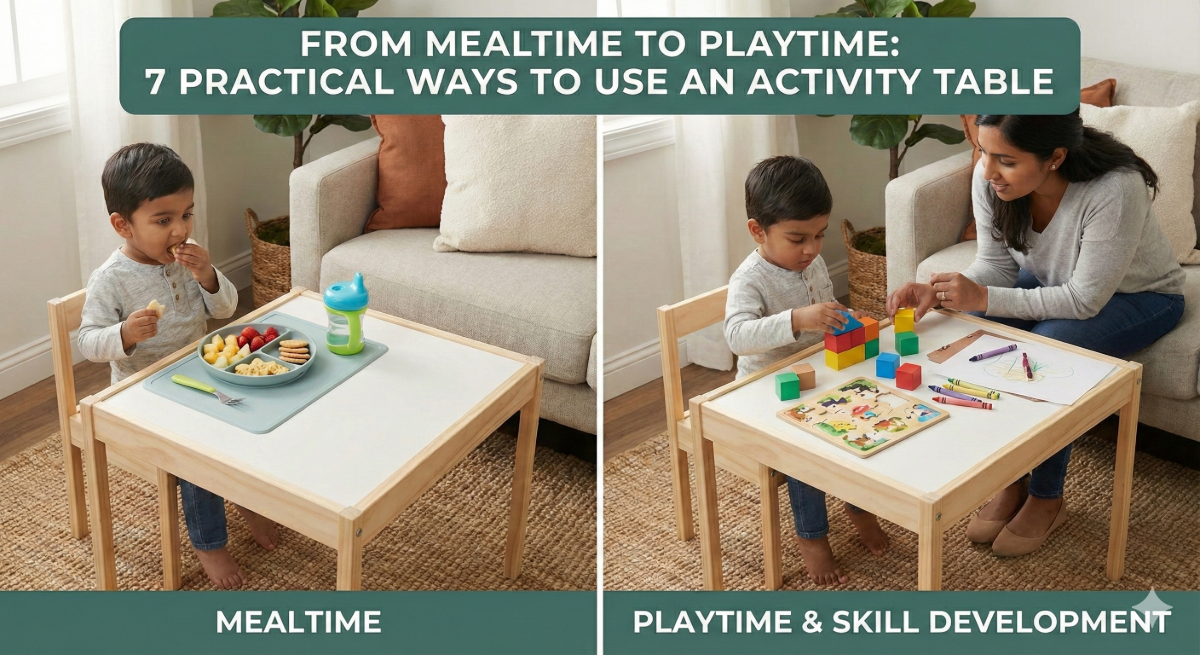
That small activity table quietly sitting in the corner of your child’s room is often underestimated. Many families see it as a casual surface—used for snacks, puzzle pieces, or random toys. In reality, with a little planning and structure, this table can become a high-impact developmental station that supports your child’s physical, cognitive, and emotional growth.
We believe meaningful development does not require expensive toys or complicated setups. What it truly needs is intention, consistency, and play-based learning. By transforming the activity table into a purposeful learning space, we can strengthen fine motor skills, improve coordination, and prepare children for school and life skills—naturally and joyfully.
This article explains the core skills involved, practical activity ideas, and most importantly, a clear 7-day routine that shows exactly what your child can do each day at the activity table.
Why the Activity Table Matters More Than We Think
Children develop best when learning feels natural. Table-based activities create a structured yet flexible environment where children can sit, focus, and explore using their hands. These experiences directly support skills required for writing, dressing, feeding, and classroom participation.
An activity table:
-
Encourages independence and concentration
-
Builds sitting tolerance for school readiness
-
Strengthens hand muscles through repeated use
-
Reduces screen dependency
-
Creates predictable learning routines
When used intentionally, this small space becomes a powerful foundation for lifelong skills.
Key Developmental Skills Built Through Table Activities
Fine Motor Skills:
Fine motor skills involve the small muscles of the hands and fingers. These are essential for tasks like holding a pencil, cutting with scissors, buttoning clothes, and using utensils. Weak fine motor control often shows up later as messy handwriting or avoidance of classroom work.
Pincer Grasp:
The pincer grasp—using the thumb and index finger together—is the foundation of proper pencil holding. Strengthening this grasp early makes writing easier, neater, and less tiring.
Hand Strength and Endurance:
Writing, coloring, and cutting all require sustained hand strength. Without it, children may press too hard, tire quickly, or develop poor grip patterns.
Bilateral Coordination:
Bilateral coordination means using both hands together in a controlled way. One hand stabilizes while the other works—an essential skill for dressing, eating, and academic tasks.
Setting Up the Perfect Activity Table at Home
A successful activity table does not need to be fancy. It needs to be child-friendly and consistent.
-
The table and chair should be child-sized
-
Feet should rest flat on the floor
-
Activities should be rotated weekly
-
Materials should be simple and familiar
-
Sessions should last 15–25 minutes
Now let us move into the most important part—the 7-day routine that shows exactly how to use this table effectively.
7 Days of Development: A Simple Weekly Activity Table Routine
This routine is designed to be repeated every week. Each day targets specific skills while keeping learning playful and stress-free.
Day 1: Muffin Tin Sorting (Pincer Grasp & Focus)
On Day 1, we begin with a sorting activity using a muffin tin or ice cube tray. Provide small items such as lentils, beans, or seeds. Encourage your child to pick them up using fingers, tweezers, or tongs and place them into separate compartments.
This activity strengthens the pincer grasp, improves hand-eye coordination, and builds concentration. Sorting by color or size also introduces early math and thinking skills.
Using pantry items like rajma, chana, or moong dal adds a rich sensory experience and keeps the activity cost-effective and familiar.
Day 2: Playdough Power (Hand Strength & Finger Control)
Day 2 focuses on building hand strength. Offer homemade playdough made from atta, salt, and water. Ask your child to squeeze, roll, pinch, and flatten the dough.
For an added challenge, hide small objects such as coins or marbles inside the dough and let your child dig them out using fingers. This builds deep finger strength needed for writing and cutting.
This activity also improves creativity and emotional regulation, as squeezing dough is naturally calming.
Day 3: Atta Tray Writing (Pre-Writing Skills)
On Day 3, spread a thin layer of atta or sooji on a tray or steel plate. Ask your child to draw straight lines, curves, shapes, or letters using their index finger.
This activity develops pre-writing motor patterns without the pressure of holding a pencil. The tactile feedback improves sensory awareness and finger isolation.
Children who resist writing often enjoy this activity because mistakes disappear easily, encouraging repeated practice.
Day 4: Pasta Threading (Bilateral Coordination)
Day 4 introduces bilateral coordination. Fix an uncooked spaghetti stick into a ball of playdough. Provide tube-shaped pasta like penne and ask your child to thread it onto the spaghetti.
One hand stabilizes the base while the other performs the threading action. This directly supports skills needed for buttoning, zipping, and cutting.
Threading also improves visual focus and patience.
Day 5: Coin Slot Posting (Precision & Control)
On Day 5, use a cardboard box or container with a narrow slit cut on top. Ask your child to post coins, cards, or tokens through the slot.
This activity improves precision, controlled release, and wrist stability. It closely mimics real-life tasks such as buttoning clothes or inserting cards.
Posting tasks also encourage problem-solving as children adjust angles and grip to succeed.
Day 6: Rubber Band Stretching (Advanced Hand Strength)
Day 6 focuses on advanced strengthening. Provide wooden blocks or containers and a set of rubber bands. Ask your child to stretch the rubber bands around the objects.
This requires controlled force and builds endurance in the small hand muscles. It is especially beneficial for children who tire easily during writing tasks.
Stretchy strings or resistance bands can also be used for variety and sensory input.
Day 7: Traditional Game Time (Dexterity & Social Skills)
Day 7 is reserved for fun and connection. Introduce a traditional tabletop game such as Pallanguzhi. A simple board can be made using an egg carton and seeds or beans as counters.
This activity strengthens fine motor skills through picking up small pieces, improves counting skills, and builds social abilities like turn-taking and patience.
It also connects children to cultural traditions while reinforcing essential developmental skills.
Why This 7-Day Routine Works
This routine works because it:
-
Targets different skills each day
-
Prevents boredom through variety
-
Builds strength gradually
-
Encourages consistency
-
Keeps learning playful and pressure-free
Repeating this routine weekly leads to visible improvements in hand control, attention span, and independence.
Conclusion: Small Table, Big Impact
That small activity table has the power to shape your child’s development in meaningful ways. With simple materials, thoughtful planning, and a consistent 7-day routine, we can nurture fine motor skills, confidence, and school readiness—right at home.
The most effective learning does not come from expensive tools but from intentional moments repeated daily. When play meets purpose, growth follows naturally.

