
The Rise of ADHD in Schools: Are We Recognising More Children, or Labelling Behaviour Too Quickly?
A child psychologist on why a restless child is a starting point for curiosity, not a diagnosis — and four ways parents and teachers can avoid labelling behaviour too quickly.

Guest article by Neha Khilwani, child psychologist, school counselor and founder of Bachpan Ke Panne.
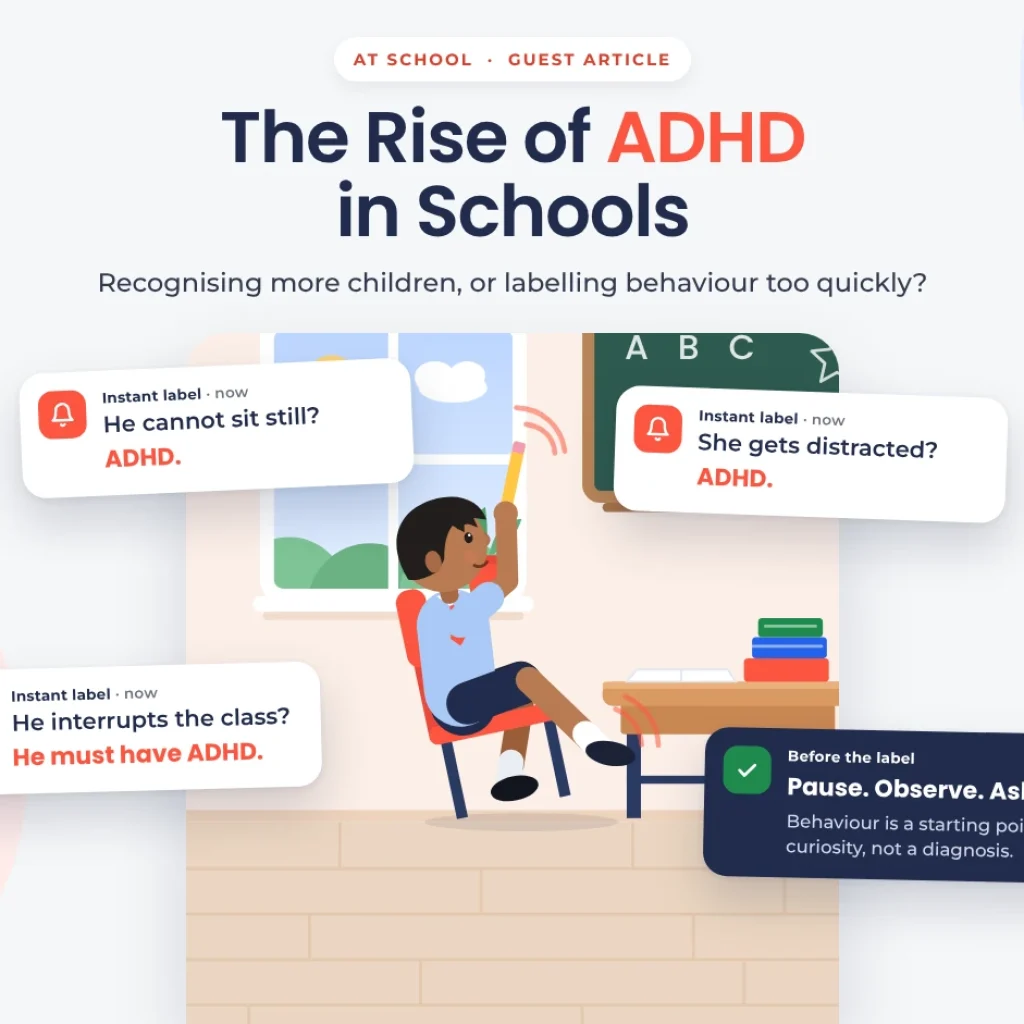
Imagine you are scrolling through your favourite food-delivery app when a notification pops up: “Your favourite meal is just a tap away!” Before you can decide what to order, another alert appears.
Now imagine the same thing happening whenever a child behaves unexpectedly.
“He cannot sit still? ADHD.”
“She gets distracted? ADHD.”
“He interrupts the class? He must have ADHD.”
Like an instant notification, the label appears, offering a quick explanation for behaviour we do not yet understand.
As conversations around child mental health become more visible, attention-deficit/hyperactivity disorder (ADHD) is increasingly discussed among parents, teachers, and schools. This awareness is necessary. But it raises an important question: Are we recognising more children who need support, or are we labelling behaviour too quickly?
When awareness becomes a shortcut
For years, children struggling with attention, impulsivity, or hyperactivity may have been dismissed as naughty, careless, disruptive, or poorly disciplined. Greater awareness can help adults recognise concerns earlier and connect children with appropriate support. That is progress.
However, information intended to help us understand children can become a shortcut when we use it to explain every behaviour we find difficult. A child who leaves their seat, looks out of the window, talks frequently, or struggles to complete a task may immediately be suspected of having ADHD.
But behaviour is a starting point for curiosity, not a diagnosis.
The concern is not that we are talking about ADHD. We absolutely should. The question is whether we are using this information to understand children better—or applying labels more quickly.
Not every restless child has ADHD
Children differ in temperament, energy levels, attention spans, emotional expression, and ways of responding to their surroundings. One child may learn best through movement, while another needs quiet. Some children take longer to engage with a task; others struggle when instructions are lengthy or the classroom feels overwhelming.
Development does not follow one uniform timetable.
ADHD is a neurodevelopmental condition involving persistent patterns of inattention and/or hyperactivity-impulsivity that interfere with functioning. It cannot be identified from one behaviour or a single classroom observation. A comprehensive assessment considers the child’s developmental history, the persistence and impact of symptoms, information from different settings, and other possible explanations.
This does not mean we should dismiss concerns by saying, “They are just children.” ADHD is real, and overlooking it can leave children struggling without support. But assuming every energetic, distracted, or impulsive child has ADHD can also be harmful.
Both under-recognition and premature labelling deserve our attention.
Before the label, look at the context
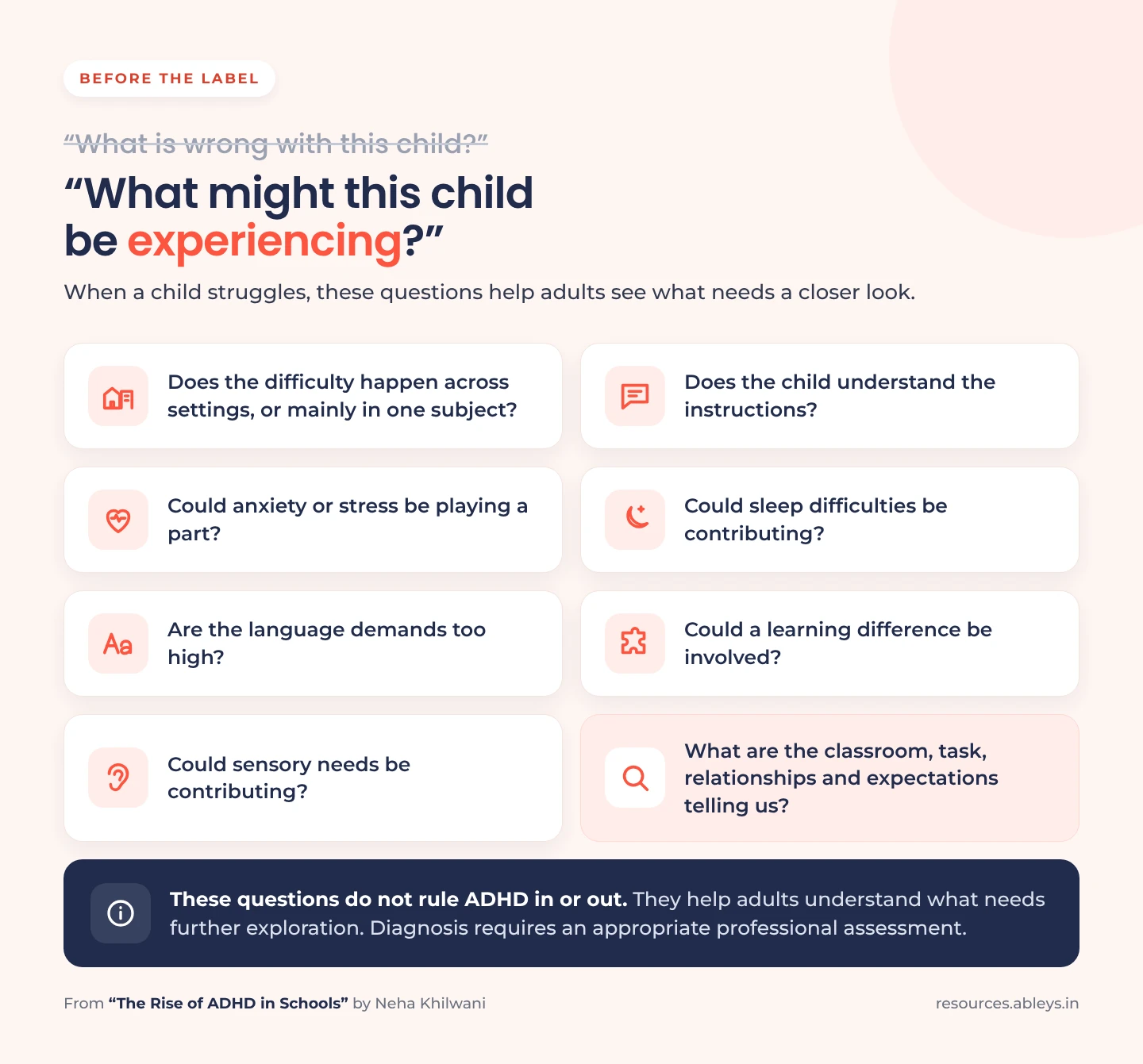
When a child struggles, perhaps our first question should not be, “What is wrong with this child?” but, “What might this child be experiencing?”
Does the difficulty occur across different settings or mainly during one subject? Does the child understand the instructions? Could anxiety, stress, sleep difficulties, language demands, learning differences, or sensory needs be contributing?
These questions do not rule ADHD in or out. They help adults understand what needs further exploration.
A child’s behaviour is influenced by both the child and their environment. If we focus only on the child, we may miss what the classroom, task, relationships, or expectations are telling us.
A restless child does not automatically need a label. They need adults who observe thoughtfully, listen without judgement, and respond to what they see.
How can we reduce premature labelling?
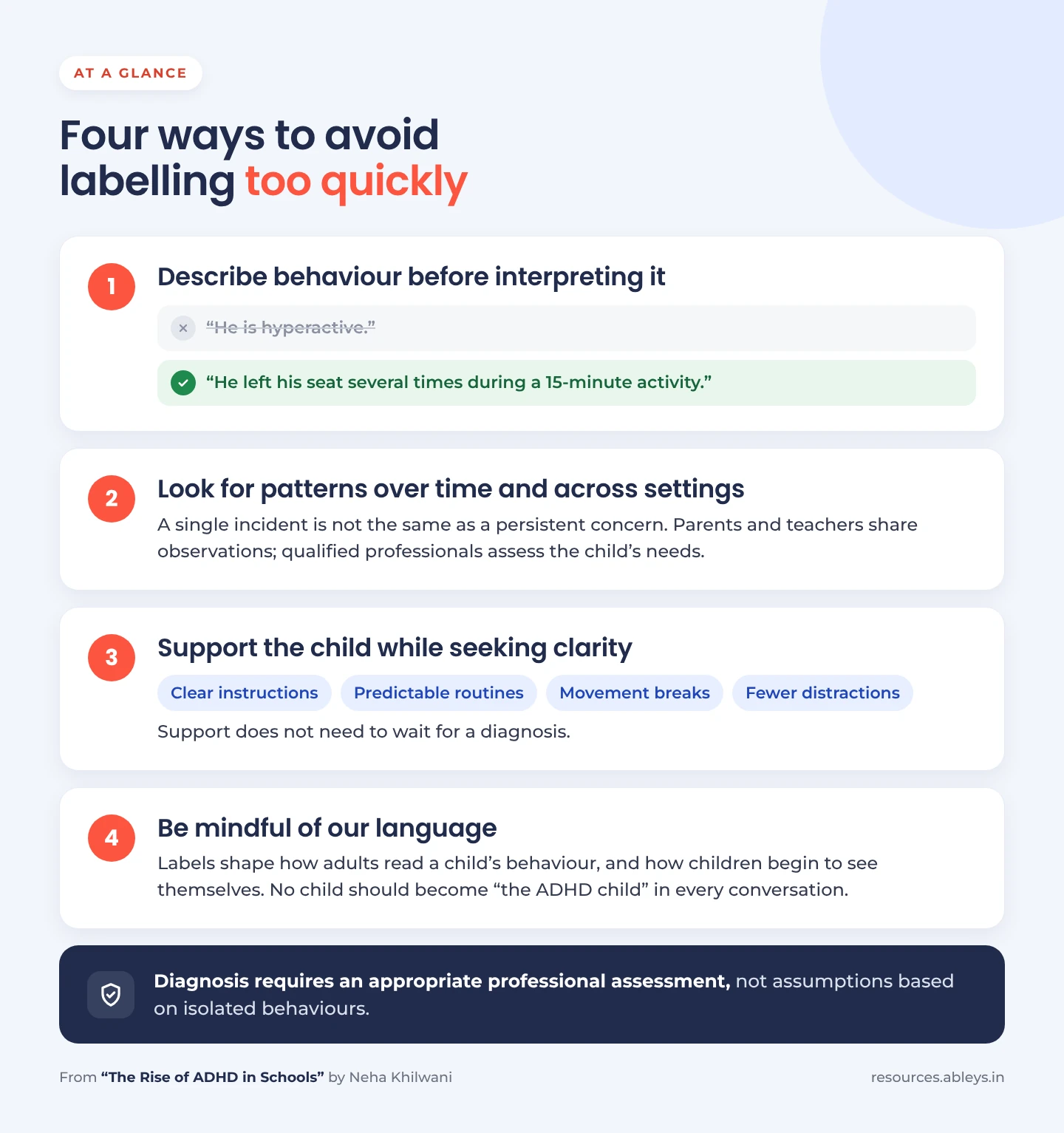
First, describe behaviour before interpreting it. Instead of writing, “He is hyperactive,” record what happened: “He left his seat several times during a 15-minute activity.” Specific observations are more useful than assumptions.
Second, look for patterns over time and across settings. A single incident is not the same as a persistent concern. Parents and teachers should share observations, while qualified professionals assess the child’s needs.
Third, support the child while seeking clarity. Clear instructions, predictable routines, appropriate movement breaks, and reduced distractions can make learning more accessible. Support does not need to wait for a diagnosis.
Finally, be mindful of our language. Labels can influence how adults interpret a child’s behaviour—and how children begin to see themselves. A child should not become “the ADHD child” in every conversation. Nor should a possible diagnosis become an insult or an explanation for everything.
Schools play an important role in observing patterns, documenting concerns, communicating with families, and creating supportive classrooms. However, diagnosis requires appropriate professional assessment, not assumptions based on isolated behaviours.
Awareness should open a door, not close the conversation
We do not need to choose between recognising ADHD and protecting children from premature labels. We can do both.
That means taking concerns seriously without rushing to conclusions, seeking professional guidance when needed, and remembering that a diagnosis should guide support—not define a child’s entire identity.
The next time a child struggles to sit still, loses focus, or interrupts, let us resist the urge to send an instant mental notification: “It must be ADHD.”
Pause. Observe. Ask questions. Consider the context. Listen to the child.
Because not every notification needs an immediate click—and not every behaviour needs an immediate label.
The real question is not simply whether we are recognising more children. It is whether we are recognising each child more thoughtfully.
About the author
Neha Khilwani is a child psychologist, school counselor, and founder of Bachpan Ke Panne, an initiative focused on making mental-health conversations more accessible to children, parents, and the wider community.