


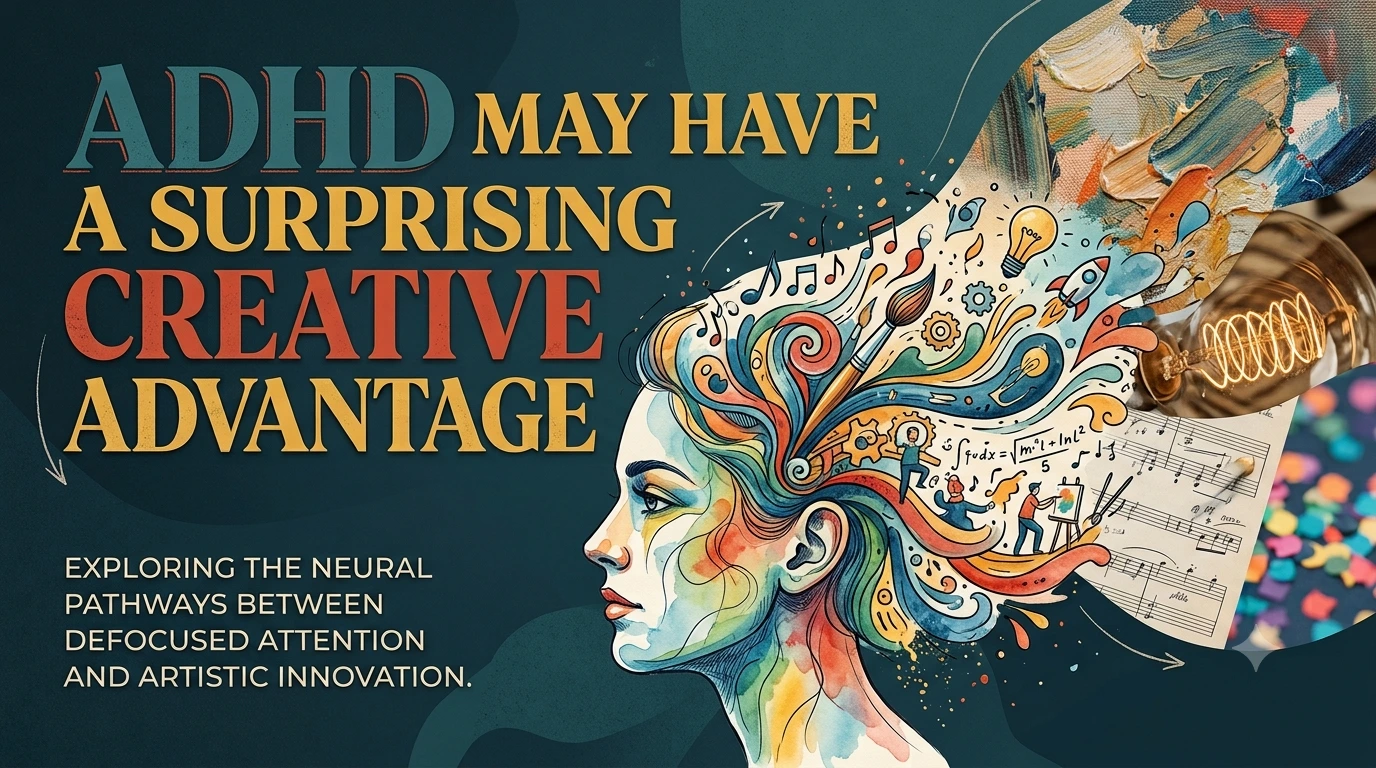
The same attention habits that make ADHD challenging can also trigger creativity by helping the brain explore more ideas and unusual connections. Researchers believe creative projects can guide this “unfocused attention” while building up the brain networks needed for focus and self-control.
ADHD affects millions of people, making routine tasks that demand focus, impulse control, and steady attention harder to manage. At the same time, ADHD traits appear in many successful artists and innovators, including Justin Timberlake and Simone Biles. A new study by neuroscientist Dr. Radwa Khalil from Constructor University looks into the science behind this contrast.
Rethinking ADHD Beyond Deficits
Co-authored with researchers from leading French institutions, the study is part of a larger push to rethink how people view ADHD.
“There’s a tendency to view attention-related conditions like ADHD purely through the lens of deficit: what is wrong, what is missing, or what needs to be fixed?” said Dr. Khalil.
While ADHD is usually treated as a condition defined by difficulties, Khalil noted that recent research shows attention and creative thinking depend on some of the same brain networks.
“Neurodivergent attention patterns, then, are not merely problems. They can open pathways to powerful creative thinking when directed appropriately,” she said.
The study, titled Attention Unleashed: creative therapy for thoughtful transformation, combines evidence from several fields to explain how brain systems for attention overlap with those for creativity.
For instance, the researchers point to free-associative thinking. Letting thoughts wander in unexpected directions can trigger creative insights, but this same habit shows up as distractibility and mind-wandering in ADHD.
ADHD and the Brain’s Wider Spotlight
Khalil explained this relationship using the image of a light beam:
“Think of attention like a spotlight. Most people are able to focus their beam on one thing. ADHD brains have a wider spotlight, taking in more information at once. This condition can make routine tasks that require focus challenging. However, this broader view, or ‘defocused attention’, also encourages exploratory thinking and new idea combinations, which fuel creativity.”
In short, a wider attention span makes it harder to stay focused on a single goal. However, absorbing more information and shifting between thoughts makes it easier to explore and form surprising connections.
The Healing Power of Creativity
Khalil and her team suggest these insights could lead to practical benefits for managing ADHD and similar conditions.
Activities like visual art, music, dance, writing, and gaming offer structured outlets to direct “unfocused attention.” Engaging in creative projects might also strengthen the neural pathways responsible for attention control, helping adjust habits tied to impulsivity and hyperactivity.
“Authentic creative expression is so much more than a pleasant distraction,” Dr. Khalil added. “It is engaging the same neural circuits involved in attention control, essentially providing a workout for the brain. For a child with ADHD, the experience of getting ‘lost in the moment’ when creating art or playing music may actually be strengthening their ability to focus by working with their natural cognitive style instead of against it.”
More Research Is Still Needed
While these findings are promising, the authors stress that science has not fully mapped the link between creativity and attention.
To address these gaps, the study outlines a plan for future studies, calling for cross-disciplinary teamwork, updated research methods, and long-term tracking studies.
Khalil emphasizes that changing how ADHD is managed requires combined efforts across neuroscience, art therapy, medicine, and other fields. Building this foundation will help researchers learn when creative methods work best and how to combine them with standard ADHD treatments.
Source: sciencedaily.com

