
ASD vs ADHD: Understanding the Key Differences in Children
Understand the key differences between ASD and ADHD in children. Learn how to recognise core features, overlapping signs, and practical support strategies.

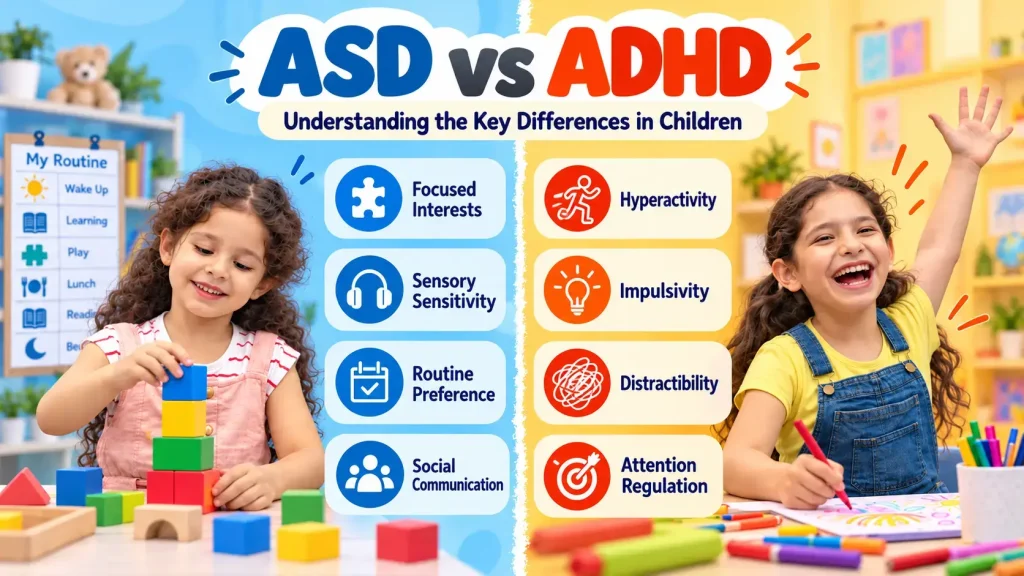
Key Differences Between ASD and ADHD
The table summarises common differences. These are general patterns, not rules; children may show different combinations of characteristics.
Area | ASD (autism spectrum disorder) | ADHD (Attention deficit /hyperactivity Disorder) |
Primary features | Social communication differences and restricted or repetitive behaviours | Inattention and/or hyperactivity and impulsivity |
Social interaction | May find social cues or conversational reciprocity challenging | May miss cues or interrupt due to distraction or impulsivity |
Communication | May communicate or use non-verbal cues differently | May speak impulsively or lose track of conversation |
Attention | May focus intensely on particular interests | May struggle to sustain attention or organise tasks |
Routines | May prefer predictability and find changes difficult | May struggle to follow routines or plan steps |
Repetitive behaviours | A core diagnostic feature | Not a core diagnostic feature |
Sensory experiences | Sensory differences may be important | Sensory difficulties may occur but are not core criteria |
Understanding the Differences in Everyday Situations
Social interaction: A child with ASD may find social cues or conversational rules challenging. A child with ADHD may miss cues because of distraction or impulsivity. Social difficulties can occur in both conditions.
Attention and interests: An autistic child may focus deeply on a particular interest or find it hard to shift from a preferred activity. Children with ADHD may have difficulty staying focused on task for long periods.Routines and transitions: A child with ASD may prefer predictable activities and find unexpected changes stressful. A child with ADHD may struggle with planning, remembering steps, or organising time. Both may benefit from preparation and clear expectations.
These examples illustrate possible support needs; they cannot diagnose a child.
ASD and ADHD: Can They Co-Exist?
Yes. ASD and ADHD can occur together. A child may have social communication differences as well as challenges with attention, activity level, or impulse control. A qualified professional can consider developmental history, strengths, needs, and behaviour across settings to understand how each condition affects the child.
How Can Parents and Educators Support Children?

Support works best when it is respectful and tailored to the child. Helpful strategies include:
- Visual supports: Use picture cues, schedules, or checklists.
- Predictable routines: Explain what happens next and prepare children for changes.
- Break tasks into steps: Give clear instructions and manageable activities.
- Reduce distractions: Create a calm workspace with needed materials nearby.
- Movement opportunities: Offer appropriate movement breaks.
- Encouragement and Appreciation.
- Support communication: Use clear language, allow processing time, and check understanding.
- Work with families: Share useful strategies between home and school.
Adjust strategies to the child’s response and individual needs.
When Should Parents Seek Professional Guidance?
Professional support can help families address their child with social communication, interaction, attention, activity level, or everyday tasks. An assessment may consider developmental history and information from home and school. No single behaviour, checklist, or classroom observation can confirm ASD or ADHD. A qualified healthcare or developmental professional can advise on next steps.
Conclusion
ASD and ADHD are distinct neurodevelopmental conditions, although some characteristics overlap. ASD primarily involves differences in social communication and interaction, together with restricted or repetitive behaviours and interests. ADHD can affect a child’s ability to concentrate ,control impulses,and manage activity levels.Some children have both.
The goal is to understand the individual child, not just compare labels. With appropriate assessment, practical strategies, and collaboration between families and educators, children can be supported to learn, build relationships, and develop their strengths.