
What Does an Occupational Therapist Actually Do?
What does an Occupational Therapist actually do? Learn how OTs promote independence and participation across all ages this World OT Day.
 Written by Satpreet KaurUpdated 31 Oct 2026 · 3 min read
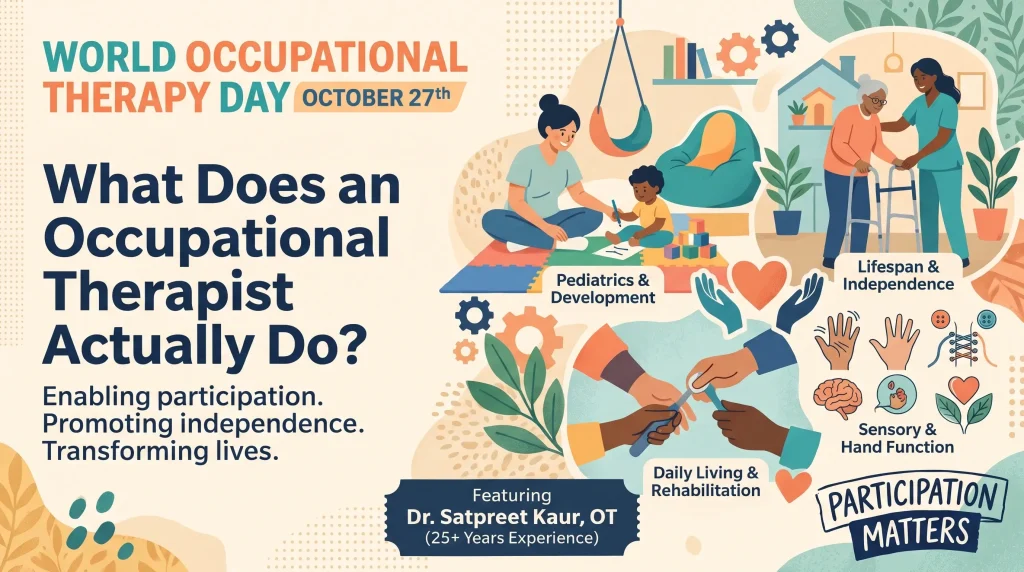
Every year, World Occupational Therapy Day 27th October reminds us of the importance of occupational therapy in helping people live more independent, meaningful, and fulfilling lives. But one question often arises: What does an Occupational Therapist (OT) actually do?
Many people believe that occupational therapy is only about exercises, hand function, or helping children with developmental delays. In reality, occupational therapy is a much broader profession that focuses on enabling people to participate in the activities that make up their everyday lives.
An Occupational Therapist does not simply treat a condition; an OT helps a person participate in life.
What does an OT actually do?
1. Helps children develop essential life skills
OTs work with children who experience developmental delays, autism, ADHD, sensory processing difficulties, learning challenges, and physical disabilities. They support the development of fine motor skills, handwriting, attention, play, coordination, emotional regulation, and independence in daily activities.
2. Makes everyday activities easier
From dressing, bathing, grooming, eating, and toileting to cooking, managing a home, and using public transport, OTs help people perform daily activities as independently and safely as possible.
3. Supports sensory processing and self-regulation
OTs assess how sensory experiences affect participation in everyday life. They may use individualized, goal-directed activities to help a person manage sensory responses, regulate emotions, improve body awareness, and participate more comfortably in home, school, and community environments.
4. Restores function after illness or injury
Following a stroke, brain injury, spinal cord injury, surgery, or other medical conditions, OTs work on functional movement, coordination, upper-limb use, cognition, and the practical skills needed to return to everyday activities.
5. Promotes independence and participation
OTs identify barriers that prevent people from participating in daily life. They may recommend adaptive equipment, assistive technology, environmental modifications, positioning strategies, or alternative ways of completing activities.
6. Supports people across the lifespan
Occupational therapy is not limited to children. OTs work with adolescents, adults, and older people experiencing physical, cognitive, developmental, or psychosocial challenges. The goal is to help each person engage in activities that are meaningful to them.
Occupational therapy is more than exercises
An OT does much more than ask a person to perform an activity. An occupational therapist:
- Assesses a person’s abilities, challenges, interests, routines, and environment.
- Identifies goals that are meaningful and relevant to the person’s life.
- Plans and interventions based on individual needs and evidence-informed practice.
- Adapts activities and environments to improve access, performance, and safety.
- Educates families, caregivers, and teachers to support progress beyond the therapy session.
- Measures outcomes to understand whether the intervention is improving participation and independence.
For example, when a child struggles with handwriting, the OT does not look only at pencil grip. They may assess posture, hand skills, visual-motor integration, attention, sensory factors, task demands, and classroom setup.
The goal is not simply to improve handwriting. It is to help the child participate successfully in learning.
Where do Occupational Therapists work?
Occupational Therapists contribute across many settings, including:
- Hospitals and rehabilitation centres
- Pediatric clinics and early intervention programmes
- Schools and special education centres
- Mental health services
- Community-based rehabilitation
- Home health services
- Geriatric care and long-term care facilities
- Workplace rehabilitation and ergonomics
Why does Occupational Therapy matter?
Because independence is not just about being able to move. It is about being able to live.
It is about a child being able to play with friends, a student participating in the classroom, an adult returning to work, a parent caring for their family, and an older person maintaining dignity and independence.
Occupational therapy recognises that every person has the right to participate in meaningful activities, regardless of age, ability, or diagnosis.
This World Occupational Therapy Day, let’s spread awareness!
An Occupational Therapist is a problem-solver, a facilitator of independence, an advocate for participation, and a partner in helping people achieve their fullest potential.
We don’t just focus on what a person cannot do. We discover what they can do, identify what is holding them back, and find ways to help them participate.
Because sometimes, the smallest achievement in therapy can make the biggest difference in someone’s life.
Occupational Therapy: Enabling participation. Promoting independence. Transforming lives.
HOW TO FIND AN OCCUPATIONAL THERAPIST IN YOUR CITY?
- He/she should have done an OCCUPATIONAL THERAPY(BOT/MOT) degree course, there is no diploma course in OT.
- He/she should be registered with AIOTA.
- He/she must be certified in Sensory Integration Therapy if providing SI Therapy.
Happy World Occupational Therapy Day! – “PARTICIPATION MATTERS”
Dr.Satpreet Kaur
Founder of Ummeed Occupational Therapy Clinic, Meerut.
Occupational Therapist (Experience 25+ years )
Brain Gym Movement Facilitator
Certified in SENSORY INTEGRATION, OPT, THERAPEUTIC LISTENING TECHNIQUES, SOSI-M & COP-R, M.OR.E, DIR FLOORTIME